

Sequencing a Full Mouth Rehabilitation: Anterior or Posteriors First?

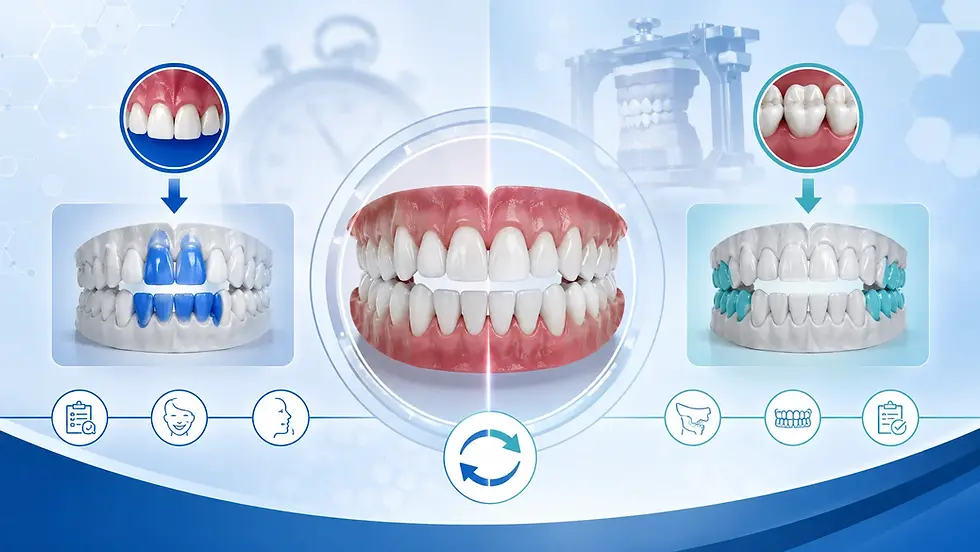
You have diagnosed the case. Mounted your casts. Evaluated Centric Relation (CR), assessed the Vertical Dimension of Occlusion (VDO), and mapped out a comprehensive full mouth rehabilitation plan.
But then comes the real clinical question: Where do you actually start?
Do you begin with the anteriors to establish aesthetics and guidance-or stabilize the posteriors first to secure function?
This is one of the most common and critical decision points in Full Mouth Rehabilitation. Because sequencing isn’t just about convenience; it directly influences occlusal stability, temporomandibular joint health, and long-term success.
The Case for Anteriors First
Starting with the anterior segment is often preferred in cases where aesthetics and guidance are primary concerns.
When it makes sense:
Severe anterior wear or collapse of incisal edges
Patients with high esthetic expectations
Cases requiring correction of smile line, lip support, and phonetics
When anterior guidance is completely lost or compromised
Clinical advantages:
Establishes anterior guidance earlyYou define how the mandible will disclude during excursions
Improves phonetics and esthetics firstImmediate patient satisfaction and better communication
Acts as a blueprint for posterior disclusionOnce anterior guidance is set, posterior occlusion can be designed accordingly
Limitations to consider:
Without stable posterior support, anterior restorations may be overloaded
Risk of inaccuracies if VDO is not properly established beforehand
Clinical insight:If you are choosing anteriors first, ensure that your CR record and proposed VDO are validated, often through mock-ups or provisional restorations.
The Case for Posteriors First
In many full-arch rehabilitations, especially worn dentition cases, starting posteriorly provides a foundation for functional stability.
When it’s the better approach:
Generalized attrition with loss of VDO
Collapsed posterior support
Patients with occlusal instability or parafunctional habits
Cases involving temporomandibular joint (TMJ) symptoms
Clinical advantages:
Re-establishes VDO predictably Posterior stops help define vertical dimension with stability
Creates stable Centric Relation contacts Essential for long-term occlusal harmony
Reduces load on anterior restorations Proper posterior support distributes forces efficiently
Limitations to consider:
Delays visible esthetic transformation
Requires precise planning to later integrate anterior guidance
Clinical insight:Posterior-first sequencing is often safer in functionally compromised cases - but only if you maintain a clear plan for integrating anterior guidance afterward.
The Verdict: A Systematized Approach
Here’s the reality Full Mouth Rehabilitation is never one-size-fits-all.
The correct sequence depends entirely on the patient’s biological, functional, and esthetic presentation.
A practical decision framework:
Start with anteriors when:
Esthetics and phonetics are the primary concern
Anterior guidance is lost and needs redefinition
VDO is acceptable or minimally altered
Start with posteriors when:
There is significant loss of VDO
Posterior support is compromised
You need to stabilize CR before aesthetic work
The Transitional Approach (Most Predictable)
Experienced prosthodontists often use a phased or transitional sequencing strategy:
Establish CR and tentative VDO using provisionals
Develop anterior guidance in mock-up phase
Sequentially restore posteriors while maintaining guidance
Finalize anterior restorations after functional validation
This approach minimizes risk and allows continuous evaluation of function, comfort, and esthetics.
Key takeaway: Sequencing is not about choosing sides - it’s about clinical judgment, planning, and adaptability.
Master Case Sequencing at Dr Khullar’s Dental Academy
If you have ever felt unsure about where to begin in a Full Mouth Rehabilitation case, you are not alone and more importantly, you don’t have to figure it out alone.
At Dr Khullar’s Dental Academy in Gurgaon, dentists are trained to approach complex cases with clarity, structure, and confidence.
Among the most practical dental courses in Delhi NCR, the academy focuses on:
Real-case treatment planning
Step-by-step sequencing protocols
Hands-on execution under expert supervision
Their Full mouth rehabilitation course in Delhi NCR is designed to eliminate confusion around:
CR vs CO decision-making
VDO assessment and modification
Anterior vs posterior sequencing
Occlusal scheme selection
This FMR course in Delhi NCR doesn’t just teach theory - it gives you repeatable clinical workflows you can apply immediately in your practice.
Know Your Mentor
Dr. Divij Khullar M.D.S. Prosthodontics | Full Mouth Rehabilitation & Implant Specialist
Dr. Divij Khullar brings a depth of prosthodontic expertise that transforms complex concepts into clear, chairside protocols.
His teaching focuses on simplifying decisions like case sequencing helping dentists move from confusion to confidence. Under his mentorship, what once felt overwhelming becomes structured, logical, and predictable.
Stop Second-Guessing Your Clinical Decisions
Uncertainty in sequencing can delay treatment, affect outcomes, and hold you back from taking on high-value cases.
The difference between hesitation and mastery lies in guided clinical experience.
If you are ready to approach Full Mouth Rehabilitation with clarity and confidence:
Take the next step toward becoming a dentist who doesn’t just plan complex cases but executes them with precision.


Comments