

What Is the Ideal Sequence for Preparation and Temporization in FMR Cases?

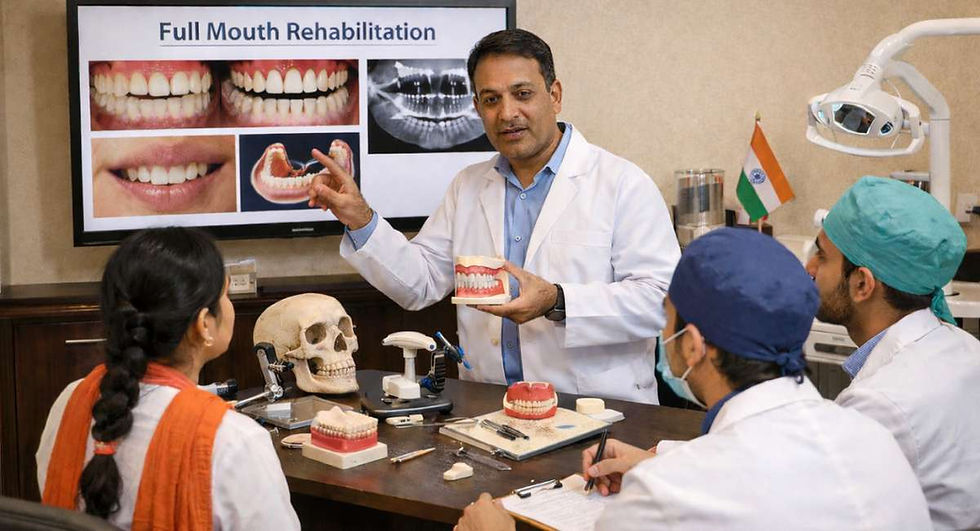
Full Mouth Rehabilitation is a highly technique-sensitive procedure that demands meticulous planning and execution. Among the most critical phases of treatment are tooth preparation and temporization. An improper sequence can compromise occlusion, esthetics, patient comfort, and long-term prognosis. For dentists and advanced dental students, understanding the ideal workflow is essential to achieve predictable outcomes in Full Mouth Rehabilitation cases.
This blog outlines a step-by-step, clinically accepted sequence for preparation and temporization in full-mouth cases.
Why Sequence Matters in Full Mouth Rehabilitation
In Full Mouth Rehabilitation, multiple teeth are restored simultaneously, often involving changes in vertical dimension, occlusal scheme, and esthetic parameters. A structured sequence ensures:
Occlusal stability throughout treatment
Patient comfort and adaptability
Preservation of centric relation and vertical dimension
Accurate evaluation of function and esthetics
Without a systematic approach, errors made early in the process can multiply during final prosthesis fabrication.
Step 1: Diagnosis and Treatment Planning
Every Full Mouth Rehabilitation begins with comprehensive diagnosis. This includes:
Clinical examination and occlusal analysis
Facebow transfer and mounted diagnostic casts
Evaluation of vertical dimension of occlusion (VDO) Diagnostic wax-up
The wax-up serves as the blueprint for preparation depth, occlusal scheme, and temporization design.
Step 2: Establishing Occlusal Reference and VDO
Before initiating tooth preparation in Full Mouth Rehabilitation, the desired VDO must be confirmed. This is often achieved through:
Occlusal splints
Mock-ups or trial provisionals
Provisional increase in VDO (if required)
Stabilizing occlusion at this stage prevents occlusal discrepancies later in treatment.
Step 3: Segmental Tooth Preparation
Rather than preparing all teeth at once, Full Mouth Rehabilitation is best managed using a segmental approach:
Prepare one quadrant or arch segment at a time
Maintain stable occlusal stops in unprepared segments
Preserve centric relation throughout the process
This controlled approach reduces patient discomfort and allows better intra-operative accuracy.
Step 4: Immediate Temporization
Temporization is not merely a placeholder in Full Mouth Rehabilitation-it is a diagnostic and therapeutic tool. Provisional restorations help evaluate:
Occlusal scheme
Phonetics
Esthetics and smile line
Patient comfort and adaptation
Provisionals should ideally be fabricated using a matrix derived from the diagnostic wax-up to ensure accuracy.
Step 5: Functional Evaluation of Temporaries
One of the most important stages in Full Mouth Rehabilitation is assessing provisional restorations over time. During this phase, dentists evaluate:
Occlusal contacts in centric and eccentric movements
Muscle comfort and TMJ response
Speech and mastication
Any necessary adjustments should be made at the provisional stage rather than after final cementation.
Step 6: Refinement and Final Preparation Adjustments
Based on feedback from provisional restorations, final refinements are carried out. This step ensures that the definitive prosthesis replicates the function and esthetics of successful temporaries, which is a cornerstone principle of Full Mouth Rehabilitation.
Importance of Structured Training
Mastering preparation and temporization protocols in Full Mouth Rehabilitation requires hands-on experience and guided learning. Dentists often enhance their skills by enrolling in a Full Mouth Rehabilitation Course in Delhi NCR, where these sequences are taught using live cases and simulations.
Institutions such as Dr Khullar's Dental Academy emphasize evidence-based workflows, helping clinicians translate theory into predictable clinical outcomes.
Conclusion
The success of Full Mouth Rehabilitation depends not only on final restorations but on the precision of preparation and temporization. A systematic, stepwise approach ensures occlusal stability, patient comfort, and long-term success. For dentists and dental students, mastering this sequence is fundamental to delivering functional, esthetic, and durable rehabilitative care.
Understanding and practicing the ideal sequence transforms complex full-mouth cases into controlled, predictable procedures.


Comments